
Social Media as Marketing: What It Means and How to Start
Social media as marketing means using platforms such as Facebook, Instagram, TikTok, LinkedIn and YouTube to get your business noticed, start conversations with customers and turn that attention into sales. It combines free posts, paid ads, replies to comments and messages, and the numbers you check to see what is working. Instead of waiting for people to find your website, you show up where they already spend their time.
This guide covers what you need beyond the definition. You will see why marketing on social media works, how to start in a few clear steps, which platforms fit which businesses, what to post and what to spend, and how to measure results. It also answers whether AI will replace the people who do this work.
Blue Growth Consulting is a Mauritius-based digital and branding agency. We run Facebook and Instagram marketing for small and local businesses every day. The advice below reflects what we see when owners with little time and a tight budget try to win customers online.
Why social media works as a marketing channel
Social media works as a marketing channel because it puts your business in front of people who are already online, lets you talk to them directly, and lets you start with a small budget. Statista estimated about 4.95 billion social media users worldwide in 2023, which is more than 60% of the world's population. Whatever your customers look like, a large share of them scroll a feed every day.
Brand awareness: being seen, then remembered
Regular posts make your name familiar. Most people do not buy the first time they meet a business. They see it several times, in a post, an ad or a friend's share, before they trust it enough to ask a question. Repeated, consistent visibility is what turns a stranger into a customer.
A complete business page also changes how you look. A clear logo, good photos and visible contact details make a small company look established and credible. That matters when a stranger compares you with the competitor down the road.
Engagement: turning followers into relationships
Social media is the only marketing channel where customers answer back. When you reply to comments, messages and mentions, you build trust and loyalty in public, where other potential buyers can see how you treat people. A shop that answers a price question within the hour looks reliable.
The reactions also teach you something. Likes, shares, comments and clicks show which topics and offers your audience cares about. Use that to decide what to post next, instead of guessing.
Sales: from attention to enquiries
Social media drives sales by sending interested people to a place where they can buy or ask: your website, your online store or a WhatsApp chat. Paid ads let you target by location, age, interests and behavior, so a local business can reach only people nearby who might want its product. Each goal needs different actions and different numbers.
| Goal | What you do | What to watch |
|---|---|---|
| Awareness | Post regularly, run reach ads | Reach, new followers |
| Engagement | Reply to comments, ask questions, run polls | Comments, shares, messages |
| Traffic | Link posts and ads to your site or store | Link clicks |
| Sales | Promote offers and products, chat on WhatsApp | Enquiries, orders, cost per enquiry |
The honest downsides
Marketing a business on social media is not free money. It has real costs, and you should know them before you start:
- Results build over weeks and months, not days.
- You need to post consistently, which takes time or a person who does it for you.
- Paid reach stops when the ad budget stops.
- Platform rules and algorithms change, so your reach can drop without warning.
- Criticism and complaints appear in public.
None of these is a reason to skip it. They are reasons to start with a plan and realistic expectations.
Social media rewards consistency far more than cleverness.
How to start marketing your business on social media
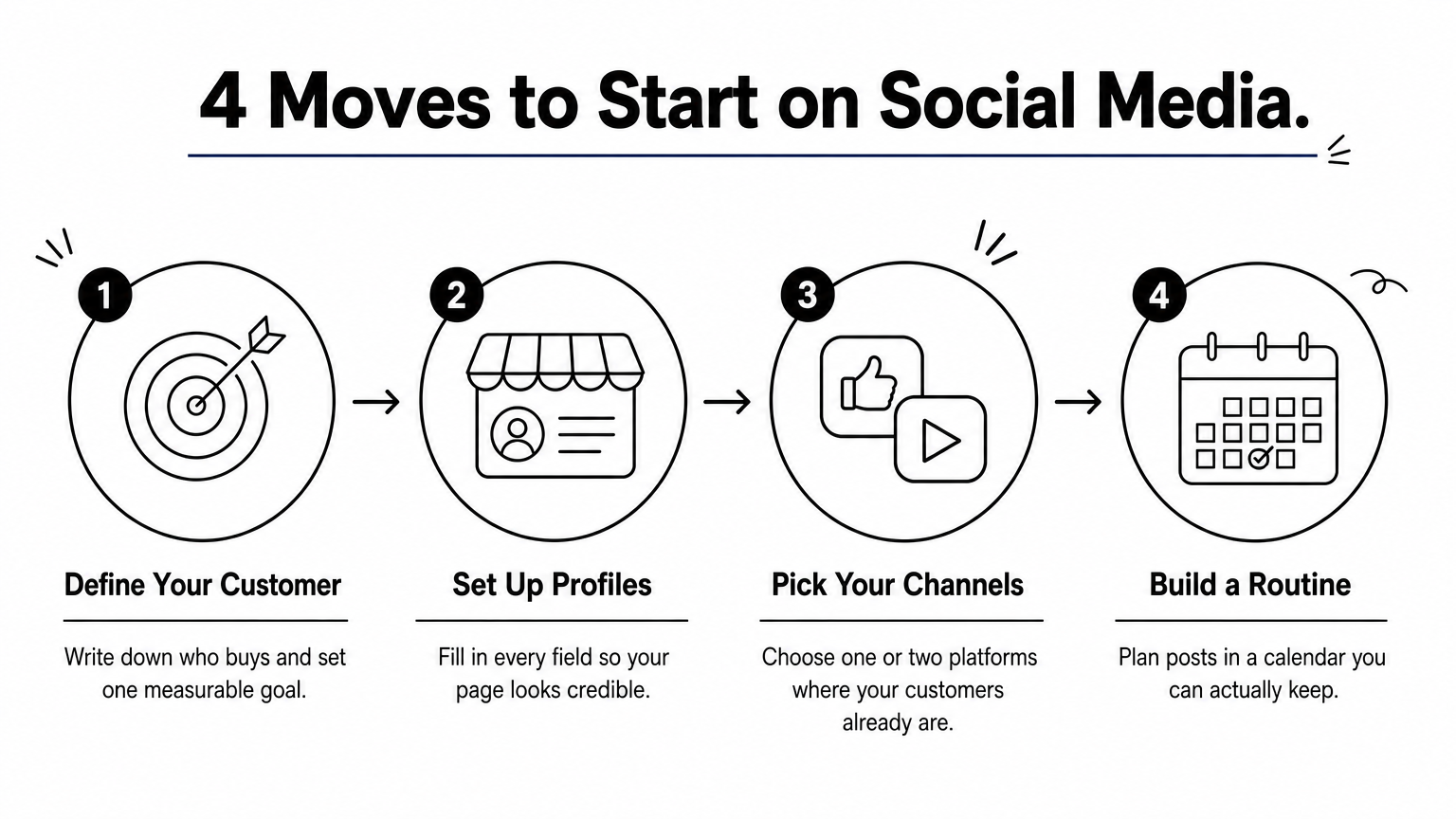
To start, define your customer and one measurable goal, set up credible profiles, pick one or two channels and follow a posting routine you can keep. Those four moves matter more than any tool or trick.
Define your customer and one clear goal
Write down who you want to reach. Note their age range, where they live, what they do for work, which apps they use, what they need and what makes them hesitate. If you do not know yet, check your past sales to see who already buys from you, then talk to three or four of those customers.
Next, set a goal with a number and a deadline. "Get more followers" is not a goal. "Receive 20 WhatsApp enquiries a month from Facebook and Instagram within three months" is one. It names a result, a channel and a time limit, so you can tell later whether it worked.
A goal you cannot measure is only a wish, so write down a number and a deadline.
Set up profiles that look credible
Your profile is your shop window. People check it before they message you, so fill in every field. Use this checklist:
- A logo as the profile picture that stays readable at thumbnail size
- A cover image in your brand colors
- One sentence that says what you offer and who it is for
- A working phone number, WhatsApp link and website link
- The same business name and handle on every platform
If you do not have a logo or brand colors yet, fix that first. Posts built on a messy identity are hard to remember.
Build a posting routine you can keep
Plan your posts in a simple content calendar: the day, the channel and the type of post. Many marketers aim for three to five posts a week per account. If you are a one-person business, two good posts a week that you actually publish beat five that you abandon in week three.
Decide on a brand voice before you write. Are you friendly and light, or polished and premium? Pick one and use it everywhere, so customers know what to expect from you.
Finally, look at two or three competitors. See which formats get comments and which get silence. Learn from both, and do not copy them.
Choosing the right platforms for your business
Choose platforms by where your customers spend time and what you can produce consistently, not by which network is biggest. Most small businesses do well with one or two.
What each platform does best
Each network has a different strength, so the same post rarely works everywhere. This table sets out where each fits.
| Platform | Typical audience | Best for | Formats that work |
|---|---|---|---|
| Broad, adults of many ages | Paid ads, local business pages, community | Images, video, Live | |
| Millennials and Gen Z | Visual products, brand awareness, influencers | Reels, Stories, photos | |
| TikTok | Gen Z and young adults | Awareness through short video | Short-form video |
| Working professionals | B2B marketing, lead generation | Text posts, images, articles | |
| YouTube | Wide range | Tutorials, explainers, brand stories | Long-form video |
| X | News followers, brand followers | Real-time updates, customer service | Short posts, video |
| Customers who already know you | One-to-one questions, quotes, orders | Chats, catalogs |
WhatsApp is a messaging app, not a feed, but for many businesses in Mauritius it is where a customer asks the price and places the order. Treat it as the destination that your Facebook and Instagram content points to.
How many platforms to start with
Start with one or two. Guides often suggest three to five channels at most, but that assumes a team. If you are doing this yourself, two platforms done well will outperform six done badly.
For a business that sells to consumers, Facebook and Instagram plus WhatsApp is a sensible starting set. For a business that sells to other businesses, add LinkedIn. Do not push a channel at the wrong audience. A product for older shoppers will struggle on TikTok, and a teen brand will go unnoticed on LinkedIn.
Pick the two platforms where your customers already are, and ignore the rest until those work.
What to post and how much to spend
Mix useful, human content with a modest ad budget. Organic posts build trust, and paid ads put your best posts in front of people who do not follow you yet.
Content types that work for small businesses
You do not need to be creative every day. Rotate through a handful of formats:

- Product or service spotlight: show one item and say who it is for.
- Behind the scenes: show how you make, pack or deliver.
- Customer stories: share a happy customer, with their permission.
- Short videos: a 15 to 30 second clip shows personality quickly.
- Offers: announce a discount, a bundle or a limited batch.
- Polls and questions: invite replies and learn what people want.
- Local events: show you are part of the community.
Before you publish, ask whether the post helps, shows or invites. A post that does none of the three is filler.
Organic versus paid
Organic posts mostly reach people who already follow you, so they build trust with your existing audience. Paid ads reach new people, because you choose who sees them. On Meta, which runs Facebook and Instagram ads, you can target by location, age, interests and behavior.
Start with one campaign and one objective, such as getting messages or website visits. Run it for a few weeks before you judge it. Changing everything every three days tells you nothing.
A worked budget example
Take a small clothing boutique that wants regular posts and one ad campaign. Under Blue Growth's Digital Starter package, the monthly fee is Rs 6,000 with no onboarding fee. That covers 8 posts a month, which is two a week, plus management of one Meta campaign and a monthly report. The ad budget goes to Meta separately. If the owner sets Rs 4,000 for ads, the total monthly outlay is Rs 10,000 (Rs 6,000 plus Rs 4,000).
| Package | Monthly fee | Posts per month | Active Meta campaigns | What else is included |
|---|---|---|---|---|
| Digital Starter | Rs 6,000 | 8 | 1 | Facebook Business Page creation or optimization, basic targeting, monthly performance summary |
| Growth Accelerator | Rs 15,000 | 12 | Up to 2 | Audience and creative testing, weekly monitoring, detailed monthly report, monthly 30-minute consultation |
Neither package includes the ad budget. No agency can honestly promise rankings, traffic, leads or sales, and we do not. What you should expect is clear reporting on what was done and how it performed.
Budget for two lines, the fee for the work and the ad spend that Meta bills you, and never confuse them.
Measuring results and where AI fits in
Measure the numbers that connect to your goal. Reach and engagement show whether people notice you, while enquiries and cost per enquiry show whether the effort pays.
Metrics worth checking every month
Pick a handful and review them on the same day each month. Every major platform has built-in analytics, so you need no extra software.

- Reach: how many people saw your content.
- Engagement: likes, comments, shares and saves.
- Follower growth: how many new people chose to see more from you.
- Link clicks: how many people left the post to visit your site or store.
- Enquiries: messages, calls and form submissions that came from social media.
- Cost per enquiry: ad spend divided by enquiries.
The last one tells you whether ads are worth it. If you spend Rs 4,000 on ads and get 20 enquiries, each one costs Rs 200 (4,000 divided by 20). If next month the same budget brings 25 enquiries, the cost falls to Rs 160, and you know the change helped.
Mistakes that waste budget
Most disappointing results trace back to a short list of errors:
- Posting without a goal, so there is nothing to measure
- Spreading across six platforms and doing none well
- Leaving comments and messages unanswered for days
- Boosting posts with no clear audience or objective
- Judging a campaign after one week
Fix these before you spend more on ads. More budget does not repair a weak plan.
Will AI replace social media marketing?
No. AI is good at speed. It drafts captions, turns product photos into ad visuals, schedules posts and sends first replies. People still decide the strategy, brand voice and offer, and they handle the awkward complaint that needs a real human answer.
Blue Growth offers two add-ons built on that division of labor. The AI Social Media Manager costs Rs 3,500 a month. It turns product photos and descriptions into ready-to-publish ads and posts them daily to connected Facebook, Instagram and TikTok profiles. The Social AI Sales Agent costs Rs 2,300 a month. It replies to comments and messages, answers product questions and guides shoppers to your store. Both are available with the Core and Complete plans.
Let AI handle the repetition, and keep people in charge of the strategy and the relationships.
Start small and keep it consistent
Social media as marketing is simple to explain and hard to do consistently. You pick a customer, set one measurable goal, build a credible profile, choose one or two platforms, post a mix of useful content and measure what comes back. Paid ads speed things up once your organic basics are in place. AI can take over repetitive tasks, but it does not replace a plan or a person who cares about customers.
You do not need to do everything at once. Start with a page that looks professional, two posts a week and one clear goal for the next three months. Review the numbers monthly and adjust.
If you would rather hand the work to a team that knows the Mauritian market, book a free first consultation with Blue Growth. We will look at your business, recommend what fits your stage and confirm scope and price in writing before any work starts.